Our Philosophy · Manifesto
The New Body
of Memory
Rather than copying the past, ANATOLIYA turns the trace it left into a contemporary language of fashion.
A civilization
lives as long as
it is remembered.
Anatolia is not only the name of a land. It is the memory of cities that lived one on top of another, of beliefs, of losses and of rebirths.
Every ANATOLIYA piece carries a single story from that memory. The story comes first; the garment is designed for it.
Here the garment is not a surface; it is a living archive where the past and the present meet.
I come from a tradition in which the story is not written but sung. A stranbêj — a singer-storyteller in the Kurdish oral tradition — carries the story with his voice; the listener passes it on to the next. For years I wrote screenplays; I put the story on paper. At ANATOLIYA I change its carrier once more: this time to cloth.
What I had in mind was never a T-shirt brand. It was that anyone who touches this garment, or this page, should feel they have stepped into a world built on culture, story and design. The weight of a museum catalogue, the restraint of a contemporary fashion house.
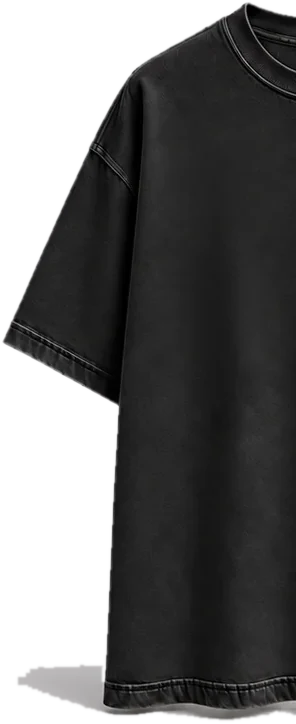
We named our first collection FOUNDATIONS: four stories, four colours. The stone of Göbekli Tepe, the Aegean blue of Ephesus, the washed black of Troy, the deep green of the peacock. We wanted each story to have its own colour and character as much as its own design.
We saw no need for the prints to be large. Our stories are already strong; rather than drawing attention by enlarging the design, we tried to say more with less. When a piece reaches you, a numbered card comes with it — not a campaign, but ownership.
We are not in a hurry. I say this not as a slogan but as a way of working.
ANATOLIYA does not tell a story to sell a T-shirt.
It designs a product to keep a story alive.
— Selman Özhan · Founder · September MMXXVI
Storyteller.

The mark is an A; but not in one piece. Eighteen stone blocks are stacked, each course stepping slightly out from the one above, with gaps as thin as mortar between them. Down the middle, from top to base, runs a cleft.
This is what you see going down through the section of an Anatolian mound: every city built on top of the one before, earth filled in between. The cleft is the cut opened to see those layers. The mark looks into an excavation.
A is a letter — the initial of ANATOLIYA and of Anatolia; so it can also stand alone. The thin horizontal cuts in the ANATOLIYA wordmark carry the same idea: the letters are layered too. It is not a copy of an ancient alphabet; the historical layer and today’s type are kept apart, neither imitates the other.
Diagram — not to scale. The layers seen in the section are the shape of the mark.